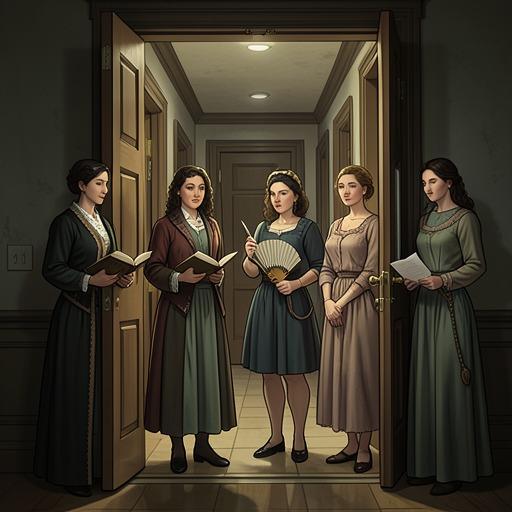
Mary Bennet
Just DesertsMary Bennet is the overlooked middle daughter of the Bennet family, but her apparent plainness and moralizing manner conceal a disciplined intelligence and a capacity for hard judgment. Initially overshadowed within Longbourn, she gradually becomes one of Elizabeth Bennet’s closest companions in thought, helping transform the older sisters from a divided family grouping into a serious and mutually protective alliance.
Identity and Family Position
Mary is eleven when the household is first described, still unmistakably a child and regarded as the least striking of the five Bennet sisters. Her position is difficult because her sisters are each attractive or socially vivid in their own ways, while she is comparatively plain. The family’s structure intensifies her isolation: Lydia Bennet is spoiled and dominant, Catherine Bennet follows Lydia’s lead, and Mary is left in the middle, neither indulged like the youngest girls nor celebrated like the older sisters.
Her principal refuge is reading the Bible. Religious study gives her a vocabulary for conduct, obedience, parental responsibility, and moral consequence, but it also contributes to the moralizing habit that makes her difficult company. Elizabeth finds Mary’s insistence on moral instruction tiresome, yet she refuses to abandon her. That persistence matters because Mary’s seriousness is not merely comic pedantry; it is the early form of a judgment that later becomes useful to the family.
Mary’s relation to Elizabeth changes as both sisters mature. Elizabeth is academically gifted and shares with Thomas Bennet a bond formed through books and curiosity, while Mary initially appears less central to that intellectual household. Over the following year, however, Elizabeth and Mary discover that they think alike and expect similar standards from other people. Jane Bennet remains Elizabeth’s closest sister in affection and temperament, but Mary becomes her intellectual counterpart: less gentle, less naïve, and more exacting about love, marriage, and male conduct.
Moral Judgment and Religious Reasoning
Mary’s religious knowledge becomes an active instrument in family disputes rather than a decorative accomplishment. When Elizabeth discusses parental authority with Jane Bennet, she brings a Bible and opens it to Ephesians, directing attention to the passage concerning fathers and children. Mary is able to follow and develop this line of reasoning because scripture is familiar territory to her. Her faith therefore participates in the family’s attempt to understand whether obedience to parents can justify coercion.
That question becomes especially urgent after Elizabeth refuses William Collins. Mary recognizes that a daughter cannot be treated as property merely because her mother wishes to preserve Longbourn. She also judges William Collins by standards more demanding than social respectability. Although she is more religious than her sisters and once considered an ordained vicar and heir to the estate an ideal husband, she concludes that Collins’s knowledge and application of Canon Law are abysmal. His clerical position cannot compensate for his ignorance and personal defects.
Mary’s reasoning distinguishes love from legal and familial pressure. Elizabeth’s refusal of Collins, as Mary understands it, was not a failure of affection but a refusal to be sold. The issue was also inseparable from Longbourn: Mary sees that Fanny Bennet values the estate more than Elizabeth and may never have offered Elizabeth the love expected from a mother. In this interpretation, religious language does not enforce submission. It exposes the moral failure of parents who provoke or abandon their children while demanding obedience from them.
Mary’s judgments are not always gentle. Elizabeth’s sisters privately acknowledge that Elizabeth possesses a ruthless streak, and Mary is capable of recognizing and engaging with that severity rather than softening every conflict. Yet Mary’s severity is directed toward principles as well as personalities. Her objection to Collins rests on Canon Law, her discussion of marriage on genuine consent, and her response to family breakdown on the consequences of conduct rather than on appearances alone.
Sisterhood and Family Crisis
As Elizabeth’s life becomes increasingly separate from Longbourn, Mary moves closer to Jane and to the newly strengthened group of older sisters. The household is no longer best understood as two pairs with Mary stranded between them. Elizabeth, Jane, and Mary form a close trio, while Catherine and Lydia remain a younger pair shaped by Lydia’s influence. The change gives Mary a social and emotional position she had previously lacked.
Mary also participates in the practical obligations that the Bennet household neglects. She joins Jane, and sometimes Catherine, in visiting tenant families, while Fanny Bennet spends freely in Meryton and among neighboring estates. These visits are not presented as fashionable accomplishments; they are part of a sober awareness that the family’s financial security is fragile and that the tenants cannot simply be ignored. Mary’s moral seriousness thus acquires a material dimension. She does not merely lecture about duty; she helps perform it.
Elizabeth’s departure from Longbourn is a shock to Mary and Jane. Elizabeth leaves two days after reaching her majority, settles in London with Edward Gardiner and Madeline Gardiner, and never returns to the parental house. A letter referring to Ephesians Chapter 6 intensifies the sisters’ discussions, especially because Verse 4, concerning parents provoking their children, has been neglected in favor of the more familiar commands to children. Mary understands that the letter confirms Elizabeth’s decision rather than inviting negotiation. The sisters recognize the bitter irony: attempts to correct the family arrive only after Elizabeth has gone, like closing the stable door after the horse has bolted.
Mary helps Jane endure the consequences. When Jane Bennet, ordinarily the calmest and most forgiving sister, is shaken by Caroline Bingley’s rudeness at Netherfield Park, Mary is the one who assists in calming her. Jane’s later recognition that Caroline’s behavior cannot be excused marks a moral awakening, and Mary’s presence gives that awakening a disciplined counterpart. Mary does not replace Jane’s gentleness or Elizabeth’s force; she helps both qualities become more discerning.
Reunions and Loyalty
After Elizabeth’s long absence, the sisters’ reunion reveals how much Mary’s place in the family has changed. When Jane sees Elizabeth for the first time in fifty weeks, she runs across the room and embraces her so enthusiastically that Elizabeth’s feet leave the ground. Mary and Catherine Bennet then join the embrace, with Mary’s welcome expressed physically rather than through one of her characteristic lectures. Their shared happiness confirms that Elizabeth’s departure did not dissolve the sisterhood. It clarified where her strongest loyalties lay.
Mary is also among the sisters whom Elizabeth most wants beside her at her wedding to Fitzwilliam Darcy. Elizabeth postpones the ceremony for six months because of her mourning period and refuses to expose the day to Thomas Bennet’s sardonic remarks or Fanny Bennet’s attempts to make the occasion about herself. Edward Gardiner is to escort Elizabeth down the aisle, but the presence of Jane, Mary, and Catherine is described as her most fervent wish. Mary’s inclusion is therefore not ceremonial. It recognizes the intellectual and emotional solidarity built after Elizabeth’s separation from Longbourn.
The sisters continue to meet in private rooms when family matters become too volatile for open discussion. Mary takes the lead in one such conversation among the three older sisters, showing that she is no longer merely the child who reads aloud or moralizes from the margins. She has become an organizer of family understanding, a person whose interpretation deserves to be heard before decisions are made.
Change and Later Life
Mary’s development is marked by a movement from abstract moral display toward practical judgment, emotional loyalty, and chosen vocation. She remains religious, but her faith becomes less an exhibition of learning than a method for examining responsibility. Her conclusions about Collins, parental authority, tenants, and family consequence show an increasing ability to connect doctrine with lived conditions.
Her later separation from Longbourn is not a rejection of her sisters. Like other members of the family, Mary spends increasing amounts of time at Grenadine Reef or with the Darcys in London, finding the Gardiner household quieter and more congenial. The change suggests that her real belonging is no longer determined by birth residence. She chooses environments in which seriousness, learning, and mutual respect can coexist.
Mary eventually marries Oliver Jackson, a devout clergyman well versed in Canon Law. The match fulfills a long-standing vision: Mary had always imagined herself as a clergyman’s wife. Her abilities, once treated as pedantry, become useful within that life. She serves as an ideal wife and perfect hostess while supporting Oliver’s ecclesiastical ambitions, and his rise from parish priest to Bishop of Oxford and a seat in the House of Lords confirms the social and institutional reach of their partnership.
Mary’s ending is consequently neither a punishment for plainness nor a reward for passive obedience. She achieves a life aligned with her convictions, expertise, and temperament. Her religious knowledge finds an appropriate field, her moral severity becomes competence, and her marginal position within the Bennet household gives way to a chosen place among the Gardiners, the Darcys, and the wider church.
Narrative Role and Significance
Mary provides the novel with a corrective to both romantic idealization and family caricature. At first she can be read as the plain, preachy middle sister, but the plot repeatedly gives her judgments weight. She understands that marriage requires consent, that clerical status does not guarantee moral or legal knowledge, that parental authority can become abuse, and that financial responsibility includes attention to tenant families.
Her relationship with Elizabeth is especially significant because it is founded on recognition rather than resemblance of temperament. Jane offers Elizabeth emotional complementarity; Mary offers intellectual affinity and a shared refusal of naïveté. Through Mary, the story shows that the supposedly forgotten daughter can become one of the family’s clearest interpreters of law, faith, gender, and consequence.
Mary’s final marriage also completes a broader pattern in which women’s capacities become meaningful when they are not forced into ornamental or purely reproductive roles. She does not cease to be exacting, devout, or intellectually serious. Instead, those qualities are finally placed in a life that values them. Her arc turns the overlooked middle position into a vantage point from which the family’s moral structure can be seen most clearly.